The short version
- Most racket sport wrist and elbow pain is overuse, where load builds faster than your tendons can adapt.
- Five exercises three times a week (slow wrist extensions, wrist curls, forearm rotations, racket tilts and grip work) build the forearm strength racket players need.
- Grip size, string tension, grip pressure and technique can all add to wrist and elbow strain, so they're worth checking.
- An elbow strap is a common option for tennis elbow, while a soft compression wrap gives wrist support without blocking movement.
- Pain that lasts more than a couple of weeks, swelling, night pain or tingling fingers needs a physio or doctor.
The best tennis wrist support is a combination of stronger forearms, a racket set-up that's kind to your arm, and, if you like the feel, a soft compression wrap that supports the wrist without stopping it moving. Five simple exercises done three times a week (slow wrist extensions, wrist curls, forearm rotations, racket tilts and grip work) will do more for most players than any brace on its own.
This guide is for tennis, padel, squash and pickleball players who are starting to feel it in the wrist or the outside of the elbow. It explains where racket sport pain usually comes from, gives you the five exercises with sets and reps, and covers grip, strings and support options.
Why do racket sports hurt your wrist and elbow?
Every shot sends force up through the racket into your hand, and your forearm muscles have to grip, steady the wrist and absorb that shock thousands of times a match. Most problems are overuse, where the load builds faster than your tendons can adapt, rather than one bad shot.
- Little-finger side of the wrist: heavy topspin forehands, whippy wrist action and twisting under load stress the tendon that runs along that edge (extensor carpi ulnaris) and the cartilage complex there, called the TFCC. A review of ECU problems in sport names tennis as one of the classic sports for it. In padel, wrist flicks on overheads and digging balls out of the corner glass can do the same.
- Outside of the elbow: this is tennis elbow, an overuse problem of the tendon where the wrist-lifting muscles attach. OrthoInfo says it's most common between 30 and 50 and is linked to technique and equipment as well as how much you play. A late, wristy one-handed backhand is the classic culprit.
- Thumb side of the wrist: lots of gripping and wrist flicking can irritate the tendons at the base of the thumb.
How do you tell which kind of pain you have?
| Where it hurts | What it might be | Read next |
|---|---|---|
| Little-finger side of the wrist, worse when you twist or hit topspin | Tendon or TFCC irritation | Pinky-side wrist pain |
| Bony outside of the elbow, worse gripping or lifting a cup | Tennis elbow | The exercises below, and a physio |
| Thumb side of the wrist, worse lifting with the thumb up | Possibly de Quervain's | Thumb-side wrist pain |
| Tingling in the fingers | Possibly a nerve, such as carpal tunnel | Carpal tunnel in active people |
This is only a rough guide, and a physio can tell you properly. If you've had a fall on court, the wrist is swollen or misshapen, or pain hasn't improved after a couple of weeks, get it checked.
5 exercises for stronger wrists in tennis and padel
Do these three times a week on non-playing days or after you play, never right before a match. Use a light dumbbell (start around 1 kg), a water bottle or your racket. A mild ache in the forearm is fine, but stop if you feel sharp pain or the ache is worse the next day. Exercises like the first one, where you lower a weight slowly, are a staple of tennis elbow rehab, and the Physiopedia tennis elbow exercise toolkit explains how physios progress them.
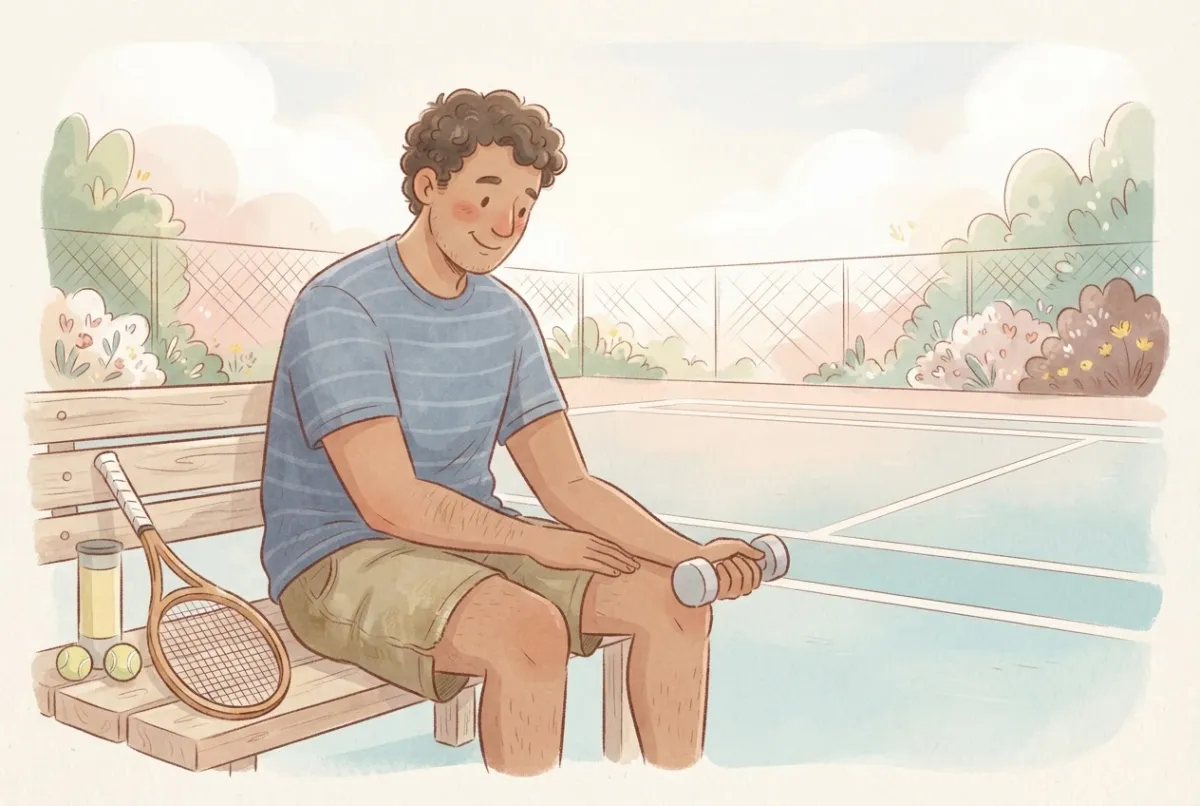
- Slow wrist extensions. Rest your forearm on your thigh, palm down, wrist just past your knee. Use your other hand to help lift the weight up, then lower it slowly over 3 to 4 seconds using only the working wrist. 3 sets of 15. You should feel the top of the forearm working, all the way up towards the elbow.
- Wrist curls. Same position with your palm up. Curl the weight up and lower it slowly. 3 sets of 15. These balance out the extensions and help your grip.
- Forearm rotations with your racket. Sit with your elbow bent at 90 degrees and tucked in, holding your racket at the handle with the head pointing up. Slowly turn the palm down until the racket is level, back to upright, then palm up. 2 sets of 10 each way. Hold higher up the throat to make it easier.
- Racket tilts. Stand with your arm by your side holding the racket like a hammer. Tip the head up in front of you using only your wrist, then down behind you. 2 sets of 12 each way. This trains the sideways wrist movements that steady the racket on impact.
- Grip and finger openers. Squeeze a soft ball (an old tennis ball is a bit firm to start with) for 5 seconds, 10 times. Then loop a rubber band round your fingers and thumb and open them wide 20 times. Racket players grip all day, so the opening part matters.
Want to go further? Our full wrist strengthening plan adds progressions, and before you play, the 7-minute wrist warm-up gets your forearms ready while your partner is still finding their water bottle.
Can your racket and grip cause wrist pain?
They can certainly add to it. A few things are worth checking with your coach or a good racket shop:
- Grip size. A grip that's too small makes the racket twist in your hand so you squeeze harder, and one that's too big also overworks the forearm. A common check is to hold your racket with your normal grip and see whether the index finger of your other hand fits in the gap between your fingertips and palm.
- String tension and type. OrthoInfo notes that equipment matters, and many players with sore arms find lower tension and softer strings (multifilament or gut rather than stiff polyester) more comfortable.
- Grip pressure. Hold the racket firmly enough to control it and relax between shots. Strangling the handle for a whole set is tiring for any forearm.
- Technique. Power should come from your legs and trunk, with the arm following through. If you're leading with the elbow on a one-handed backhand or flicking the wrist on every padel smash, a lesson or two is a very good investment.
- Load. New racket, new sport, or suddenly playing four times a week? Build up gradually and give your arm some lighter sessions.
Masha's tip: long, friendly sessions with mates count as training too, even when it's "just a knock-around". Warm up for them properly and notice how your arm feels the next day, because that's usually where the early warning shows up.
What wrist support is best for tennis and padel?
It depends on what you want it to do.
- Elbow strap (counterforce brace): a strap worn just below the elbow that OrthoInfo lists among the treatment options for tennis elbow. It's worth asking a physio whether one suits you and where to place it.
- Rigid wrist brace: useful for resting an injured wrist, but too restrictive to play in, because you need the wrist to move.
- Taping: a physio can tape the wrist for support while you return to play.
- Soft compression wrap: snug, even compression and warmth around the joint while the wrist stays free to swing. Some players simply like the more supported, connected feel, and it doubles as a reminder to keep a steady wrist through contact.
I made SneakyDeez for pole dancers, but the reason they work there is the same thing racket players need: firm elastic compression where the load is, sitting low on the wrist so your hand and grip are left alone. The 8 cm unisex pairs cover more of the wrist if you prefer that feel. They're support for comfort, not a medical device, so don't use them to play through pain.
If your whole club or doubles group is curious, you can each pick your own pair through one shared group buy link and the more of you there are, the more you save.
When should you stop playing and see someone?
Take a break and get advice from a physio or doctor if your wrist or elbow pain hangs around for more than a couple of weeks, gets worse during play, wakes you at night, comes with swelling, clicking with pain or a feeling of the wrist giving way, or if your fingers tingle. OrthoInfo notes that most people with tennis elbow improve without surgery, and getting the right exercises early is a big part of that. Our guide to wrist pain treatments explains what to expect, and if you play other sports too, have a look at wrist pain in boxing or wrist support for bowling.
More in Sports
- Wrist Pain and Numb Hands from Cycling: Bike Fit, Grips and Gloves
- Wrist Pain from Boxing: Why It Happens and How to Get Relief
- Wrist Support for Bowling: Positioners, Braces and Sore Wrists
- Best Wrist Support for Carpal Tunnel If You Train or Play Sport
Questions people ask
Should I wear a wrist brace when playing tennis?
A rigid brace is usually too restrictive to play in, because you need your wrist to move. Many players prefer a soft compression wrap for a supported feel, or physio taping when returning from an injury. If you're in pain, get it assessed rather than relying on a support to keep playing.
Why does my wrist hurt on the pinky side after tennis?
Pain on the little-finger side is often linked to the tendon that runs along that edge or the cartilage complex (TFCC) there, both of which are stressed by topspin, twisting and wristy shots. It's worth having a physio check it, especially if it clicks or feels weak.
Is padel harder on the wrist than tennis?
It loads the wrist differently. Padel bats are solid and shorter, and players often use wristy flicks on overheads and when playing off the glass, which can irritate the wrist and elbow. Building up playing time gradually and getting technique tips helps.
How long do the wrist exercises take to work?
Most people feel their forearms getting stronger within a few weeks of doing the exercises three times a week. Tendons adapt more slowly, so keep going for a couple of months and increase the weight gradually.
What string tension is best for wrist and elbow pain?
There isn't one number for everyone, but many players with sore arms find a slightly lower tension and softer strings more comfortable than stiff polyester at high tension. A good stringer can help you choose.
Shop the fix
Wraps made for exactly this
Handmade in Slovenia by a pole teacher, with firm compression that sits low on the wrist.
Sources we checked
Written by
Masha Pinner
Pole dance teacher at Pandora Art of Pole in Slovenia and former fashion designer. Masha started SneakyDeez in 2017 after years of teaching on sore wrists, and she still designs every pair.
Read Masha’s story