
The short version
- The evidence that acupressure treats wrist pain is weak, so it's best used as relaxing self-care rather than a cure.
- The most-used points for the arm and wrist sit on the forearm, the wrist crease, the web of the thumb and the outside of the elbow.
- Press with firm but comfortable pressure for 30 seconds to a minute, and stop if you feel sharp pain, tingling or numbness.
- Skip the thumb-web point (LI4) if you're pregnant, and never press on a fresh injury, swelling or broken skin.
- Pain that lasts more than two weeks, wakes you at night or comes with numbness needs a proper check, not more pressing.
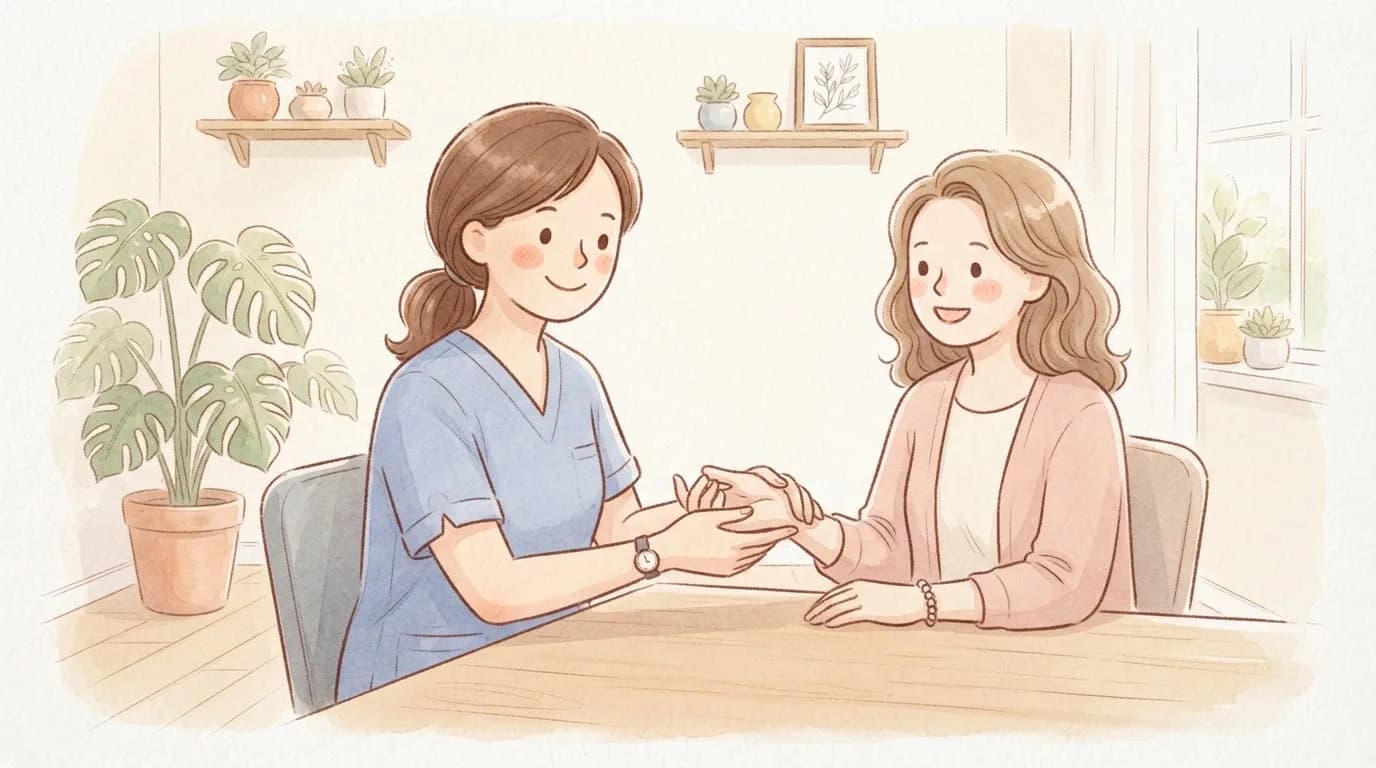
Acupressure means pressing on specific points on the body with your fingers, and for arm and wrist aches the points people use most are on the forearm, the wrist crease, the web of the thumb and the outside of the elbow. The scientific evidence that it treats wrist pain is weak, so I'd use it as a relaxing bit of self-care that may help you feel looser and calmer, alongside proper rest, strengthening and medical advice when you need it.
I like a few minutes of forearm pressing after a heavy teaching day, mostly because it makes me slow down and notice which bits are tight. Below you'll find the ten points from traditional Chinese medicine that come up most for the arm and wrist, how to find them, and how to press safely.
Does acupressure actually work for wrist pain?
Honestly, we don't know for sure. Most research has been done on acupuncture (with needles) rather than acupressure, and even there the picture is mixed. A Cochrane review of acupuncture and related treatments for carpal tunnel syndrome concluded it's uncertain whether they work better than standard options like splints or pain relief, because the evidence is low or very low certainty and mostly short term. There are some small studies where people practising self-acupressure reported feeling better, but small studies are a long way from proof.
So why bother? Pressing and massaging tight forearm muscles feels good for a lot of people, it's a gentle way to relax after training, and slowing down to breathe for five minutes rarely hurts anyone. As long as you treat it as comfort rather than cure, and you don't let it delay getting a real problem checked, it can be a nice part of your routine. If you don't know yet what's behind your sore wrist, my guide to the common causes of wrist pain is a better first step. The US National Center for Complementary and Integrative Health has a useful plain-English overview if you want to read more about the research.
Is acupressure safe, and who should skip it?
Pressing with your own fingers is low risk for most people, but there are times to leave it alone or check first:
- Don't press on a fresh injury, a swollen or bruised area, broken skin, a rash, varicose veins or any lump you haven't had checked.
- If you've had a fall and the wrist is very painful or has changed shape, get medical help instead.
- If you're pregnant, talk to your midwife or doctor first. The point in the web of the thumb (LI4) is traditionally avoided during pregnancy, so skip that one.
- If you bruise easily or take blood thinners, keep the pressure light.
- If pressing causes sharp pain, tingling or numbness, stop.
How do you do acupressure on yourself?
- Sit somewhere comfortable with your forearm resting on a table or your lap so the muscles can relax.
- Find the point using the descriptions below. Points are often slightly tender, which can help you know you're in the right place.
- Press with the pad of your thumb or middle finger, slowly building to firm pressure. On a scale of 0 to 10, keep it around 3 or 4: noticeable, maybe a bit achy, never painful.
- Hold still or make tiny circles for 30 seconds to 1 minute while breathing slowly. Release gently.
- Repeat on the other arm. You can go round the points once or twice a day.
When I say "finger widths" below, I mean the width of your own fingers laid side by side across the forearm, because that scales with your body.
Where are the acupressure points for wrist and arm pain?
1. Inner Gate (PC6, Neiguan)
Turn your palm up and place three fingers across your forearm with the edge of your ring finger on the wrist crease. The point sits just above your index finger, in the middle of the forearm between the two tendons you can feel when you make a fist and bend your wrist slightly. It's one of the best-known points, mostly studied for nausea, and many people also like it for a tired inner forearm.
2. Outer Gate (TE5, Waiguan)
Flip your arm over. The Outer Gate is on the back of the forearm, three finger widths up from the wrist crease, in the groove between the two forearm bones. It sits almost directly opposite the Inner Gate, so you can press both at once with your thumb on top and your fingers underneath, which is a really comfortable squeeze after a lot of gripping.
3. Great Mound (PC7, Daling)
This one is right in the middle of the wrist crease on the palm side, between the same two tendons as the Inner Gate. Go gently here, because this is roughly where the carpal tunnel sits, and if you have tingling in your fingers you shouldn't press hard over that area.
4. Spirit Gate (HT7, Shenmen)
Stay on the palm-side wrist crease and slide your finger over to the little-finger side. There's a small hollow just inside the tendon on that edge. It's a soft, gentle point, and a lot of people use it simply as part of a calming bedtime routine.
5. Yang Pool (TE4, Yangchi)
On the back of the wrist, find the crease and slide along it until you reach a small hollow roughly in line with your ring finger, between the tendons. It's a nice spot to press if the back of your wrist feels stiff after weight-bearing work like handstands or push-ups.
6. Yang Stream (LI5, Yangxi)
Lift your thumb up and back as if hitching a ride, and you'll see a little hollow appear on the thumb side of the back of the wrist, between two tendons. That hollow is Yang Stream. Press lightly here, because the area can be sensitive, especially if you've had thumb-side wrist pain like de Quervain's.
7. Broken Sequence (LU7, Lieque)
Find the bony bump on the thumb side of your wrist. The point is about two finger widths above the wrist crease, just above that bump, in a small groove. I find it easiest to reach by resting the hand on its side and pressing with the index finger of the other hand.
8. Joining Valley (LI4, Hegu)
Press your thumb against the side of your index finger and look for the highest point of the muscle in the web between them. Relax the hand and press there, angling slightly towards the bone of the index finger. It's probably the most famous acupressure point there is and often feels quite tender. Please skip it if you're pregnant.
9. Arm Three Miles (LI10, Shousanli)
Bend your elbow and find the outer end of the elbow crease. Measure three finger widths down the forearm towards the thumb, onto the meaty muscle there. Those are the muscles that lift your wrist and grip, so this point often feels tight in people who hold a phone, a mouse, a racket or a pole a lot.
10. Pool at the Bend (LI11, Quchi)
With your elbow bent, the point is at the outer end of the elbow crease, between the crease and the bony bump on the outside of the elbow. If you have pain right on that bony bump, which can be tennis elbow, press around it gently rather than on the sore spot, and have a look at our racket sports guide for exercises that help that area.
A 5-minute wind-down routine for tired wrists
If you want a simple sequence to follow after training or a long day at the keyboard, try this on each arm:
- Warm the forearms (1 to 2 minutes). Rest a warm heat pack over your forearms or simply rub them with your opposite hand until they feel warm.
- Squeeze the Gates (1 minute). Press the Inner and Outer Gates together, thumb on top and fingers underneath, holding for 30 seconds twice.
- Elbow points (1 minute). Press Arm Three Miles, then Pool at the Bend, 30 seconds each.
- Thumb web and wrist crease (1 minute). Press Joining Valley (skip if pregnant), then gently Spirit Gate.
- Finish with movement. Five slow wrist circles each way and a few easy fist-and-spread pumps.
Masha's tip: do this somewhere you can actually relax, like on the sofa with your arm on a cushion. If you're pressing hard with your shoulders up round your ears, you're doing the opposite of what we're going for.

When is acupressure not enough?
If your wrist pain is getting worse, keeps coming back, wakes you up at night, or comes with numbness, tingling, weakness or swelling, please get it checked rather than pressing harder. The NHS advises seeing a GP if wrist pain hasn't improved after two weeks of home care, and getting urgent help after a fall or if the wrist looks deformed or you've lost feeling (NHS: wrist pain). Our overview of wrist pain medicine and treatments explains what the next steps usually look like.
What helps wrists more in the long run?
Acupressure is a nice way to unwind, but the things that make wrists more resilient are dull and effective: warming up properly, building strength gradually, and not doing too much too soon. Try our quick wrist warm-up and prehab routine before training, and when you're ready for more, follow the step-by-step plan in how to strengthen your wrists.
More in Wrist pain
- Wrist Pain Causes: Why Your Wrist Hurts and Where It Hurts
- Wrist Pain Medicine and Treatments: From Home Care to the Doctor
- Ulnar Impaction Syndrome: Symptoms, Diagnosis and Treatment
- Pain on Your Wrist Bone: Bumps, Lumps and What to Do
- De Quervain's Tenosynovitis: Thumb-Side Wrist Pain Explained
- Wrist Pain on the Pinky Side: Causes, Self-Care and When to Get Help
- Wrist Pain When Bent: Why It Hurts and 5 Ways to Ease It
Questions people ask
What pressure point relieves wrist pain?
The points used most often for the wrist are the Inner Gate (PC6) and Outer Gate (TE5) on the forearm, plus points on the wrist crease. People often find pressing them relaxing, but research hasn't shown that acupressure reliably relieves wrist pain, so treat it as comfort alongside other care.
Can acupressure help carpal tunnel syndrome?
A Cochrane review found it's uncertain whether acupuncture and related treatments help carpal tunnel symptoms more than standard care, because the evidence is low quality. Night splints and seeing a doctor or physio are the usual first steps, and you should avoid pressing hard over the carpal tunnel if you have tingling.
How long should you hold an acupressure point?
Most self-care guides suggest holding each point for about 30 seconds to two minutes with steady, comfortable pressure, while breathing slowly. You can repeat the sequence once or twice a day. More pressure is not better, so keep it to an ache rather than pain.
Which acupressure point should you avoid in pregnancy?
The point in the web between your thumb and index finger (LI4, Hegu) is traditionally avoided during pregnancy, and a few others are too. If you're pregnant, check with your midwife or doctor before trying acupressure.
Is acupressure the same as acupuncture?
They use the same points, but acupuncture uses fine needles inserted by a trained practitioner, while acupressure uses finger or thumb pressure that you can do yourself. Most of the research is on acupuncture, so even less is known about acupressure on its own.
Shop the fix
Wraps made for exactly this
Handmade in Slovenia by a pole teacher, with firm compression that sits low on the wrist.
Sources we checked
Written by
Masha Pinner
Pole dance teacher at Pandora Art of Pole in Slovenia and former fashion designer. Masha started SneakyDeez in 2017 after years of teaching on sore wrists, and she still designs every pair.
Read Masha’s story